If you are trying to choose between SEO vs Google Ads, you are really asking a deeper business question: do I need leads now, or do I need a channel that becomes cheaper and stronger over time? For small businesses, that distinction matters a lot. The wrong choice can waste budget. The right choice can build a much steadier growth engine.
SEO is usually slower and more durable. Google Ads is usually faster and more controllable. Small businesses do best when they match the channel to the stage of the business, not just the trend of the moment.
01 The simple difference between SEO and Google Ads
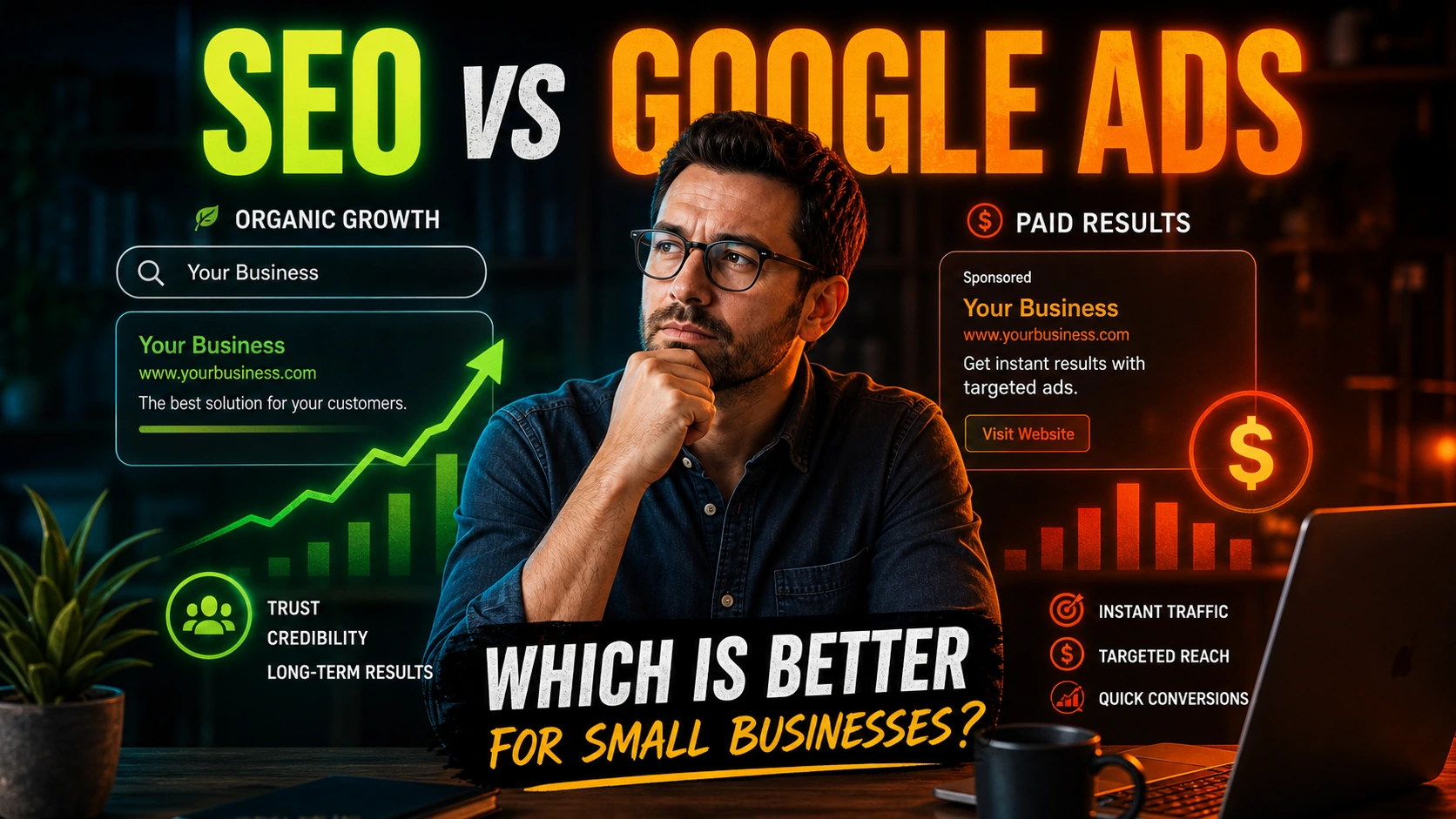
SEO helps your business appear in organic search results by improving pages, content, website structure, technical quality, internal linking, and overall search relevance. It usually takes longer, but the visibility can compound over time. Google Ads places your business in paid search placements almost immediately, as long as you are willing to keep paying for clicks.
That makes this less of a pure marketing debate and more of a timing and economics decision. If a business needs visibility this month, Google Ads has an obvious advantage. If a business wants to reduce dependency on paid acquisition over the next year, SEO becomes much more attractive.
02 When SEO is the better choice
SEO is usually the better choice for small businesses that want durable visibility, lower long-term customer acquisition cost, and stronger trust in search results. Many users still treat organic results as more credible than ads, especially when they are researching services, comparing options, or trying to understand a problem before they buy.
SEO is especially useful when your business has recurring search demand around services, local intent, comparison queries, educational topics, or product categories that people research before contacting you. If your website structure, service pages, and content are strong, SEO can keep working long after a specific campaign budget ends.
SEO is usually a better fit when
- You want long-term lead generation instead of only short bursts of traffic
- Your buyers research before contacting or purchasing
- You want to build authority and search trust over time
- You can invest patiently for compounding returns
- Your website can support content, service pages, and technical improvements
03 When Google Ads is the better choice
Google Ads for small business makes the most sense when speed matters. If you need enquiries quickly, want to test a new offer, are launching in a new market, or need a direct way to capture purchase-intent traffic now, ads are often the fastest path.
Ads also help when you do not yet rank organically, when SEO competition is high, or when you want clearer control over targeting, spend, search terms, and landing-page experiments. The strength of Google Ads is not that it is always cheaper. It is that it gives you immediate distribution and faster feedback.
Google Ads is usually a better fit when
- You need leads or sales faster than SEO can realistically deliver
- You want to validate demand before investing heavily in SEO
- You have a time-sensitive campaign, launch, or promotion
- You want tighter short-term control over budget and targeting
- Your landing pages are already strong enough to convert paid traffic
04 SEO vs PPC on ROI
If you frame the question as SEO or PPC, the ROI answer depends heavily on timeframe. In the short term, PPC can look better because it starts generating traffic faster. In the long term, SEO often looks better because you are no longer paying for every click individually, and good content or service pages can keep attracting leads month after month.
The trap is assuming ROI is only about media spend. For small businesses, ROI also depends on landing-page quality, conversion rate, sales follow-up, and whether the website actually explains the offer clearly. A weak page can waste either channel. I see that problem often on sites that need better messaging and structure, which is closely related to the work described on the web design service page.
SEO usually wins on long-term efficiency. Google Ads usually wins on short-term speed. Neither wins if the page experience is weak.
05 Lead quality is not always the same
Lead quality often differs between channels. Organic search visitors may spend more time researching and may trust the business more because they found useful content or a strong service page before making contact. Paid traffic can be highly valuable too, but it often depends more sharply on keyword intent, ad-message accuracy, and landing-page alignment.
In other words, ads can bring in excellent leads, but they can also bring expensive low-intent clicks if the targeting is broad or the offer is unclear. SEO can bring in strong leads, but it can also bring the wrong traffic if the content targets curiosity instead of buying intent. Channel performance is rarely just about the channel itself. It is about strategy quality.
06 Cost control vs compounding value
One reason small businesses like Google Ads is that the budgeting feels direct. You can start, stop, scale, and test faster. But that control comes with ongoing cost. The moment you stop paying, the traffic usually stops too.
SEO works differently. The upfront investment can feel less predictable because results take longer, but the asset value compounds. A strong service page, a well-structured local page, or a helpful comparison article can continue attracting traffic and enquiries without charging you for every visit. That is why SEO often feels slower at first but more defensible later.
07 What changed in 2026
In 2026, the conversation is not just about classic blue links anymore. Businesses now also care about AI summaries, search overviews, richer SERP features, and whether their content is visible in more AI-shaped discovery flows. That makes SEO more than just ranking for a keyword. It is increasingly about being the source search systems trust enough to surface or cite.
At the same time, paid search is still powerful because commercial intent remains valuable and immediate. That means digital marketing for business is less about picking a single winner and more about deciding which channel should do which job. SEO can support authority and lower long-term acquisition cost. Google Ads can support speed, testing, and immediate demand capture.
08 The smartest choice for many small businesses: both, but in the right order
For many small businesses, the most practical answer is not SEO or Google Ads. It is both, staged properly. Google Ads can help test offers, messaging, and landing pages fast. SEO can then strengthen the pages, expand visibility, and reduce dependency on paid traffic over time.
This is often the healthiest strategy when budget is limited but growth matters. Use ads to learn quickly. Use SEO to build staying power. Let paid traffic reveal which pages and offers convert best, then deepen those winners through stronger organic search visibility.
A practical sequence for small businesses
- Use Google Ads first if you need immediate enquiries or market validation
- Improve the landing pages based on real conversion data
- Invest in SEO once the service positioning and page structure are clearer
- Build content and organic visibility around proven commercial intent
- Reduce waste by letting each channel support the other
09 My honest recommendation
If a small business urgently needs leads and has a clear offer, decent margins, and a strong landing page, Google Ads is often the best starting point. If the business already has some traction and wants to build a more stable growth engine, SEO is usually the smarter long-term investment. If the site is weak, unclear, or slow, fix that first, because both channels will underperform on a poor foundation.
That is the part business owners often underestimate. Marketing performance is tightly tied to page clarity, trust, speed, and user experience. If you want help strengthening that foundation before putting more money into traffic, the web design service page, the article on mobile speed, and the piece on WordPress SEO tools are useful next reads.
The better channel is the one that fits the business stage
SEO and Google Ads solve different timing problems. SEO is better when you want long-term visibility, authority, and compounding ROI. Google Ads is better when you need speed, testing, and immediate demand capture. For many small businesses, the strongest answer is not choosing a side. It is choosing the right sequence. If you want help building pages that support either channel more effectively, you can review recent website projects or get in touch here.
FAQ
Common questions about SEO vs Google Ads: Which Is Better for Small Businesses?
A quick summary of the most common questions readers have about this topic.
It depends on the business stage and urgency. SEO is often better for compounding long-term visibility and lower marginal lead cost over time, while Google Ads is better when a small business needs traffic and leads quickly.
A small business should choose SEO when it wants durable organic visibility and can invest patiently, and choose PPC when it needs immediate testing, faster lead generation, or short-term campaign control.
Yes, Google Ads can be worth it for small businesses when the offer, landing page, targeting, and budget discipline are strong. They become expensive when campaigns send paid traffic to weak pages or unclear offers.
SEO often produces better ROI over a longer time horizon, while Google Ads can produce better short-term ROI when the business needs immediate enquiries, sales, or market validation.
Yes. In many cases the strongest approach is to use Google Ads for immediate demand capture and testing while building SEO for long-term visibility, trust, and lower acquisition cost.