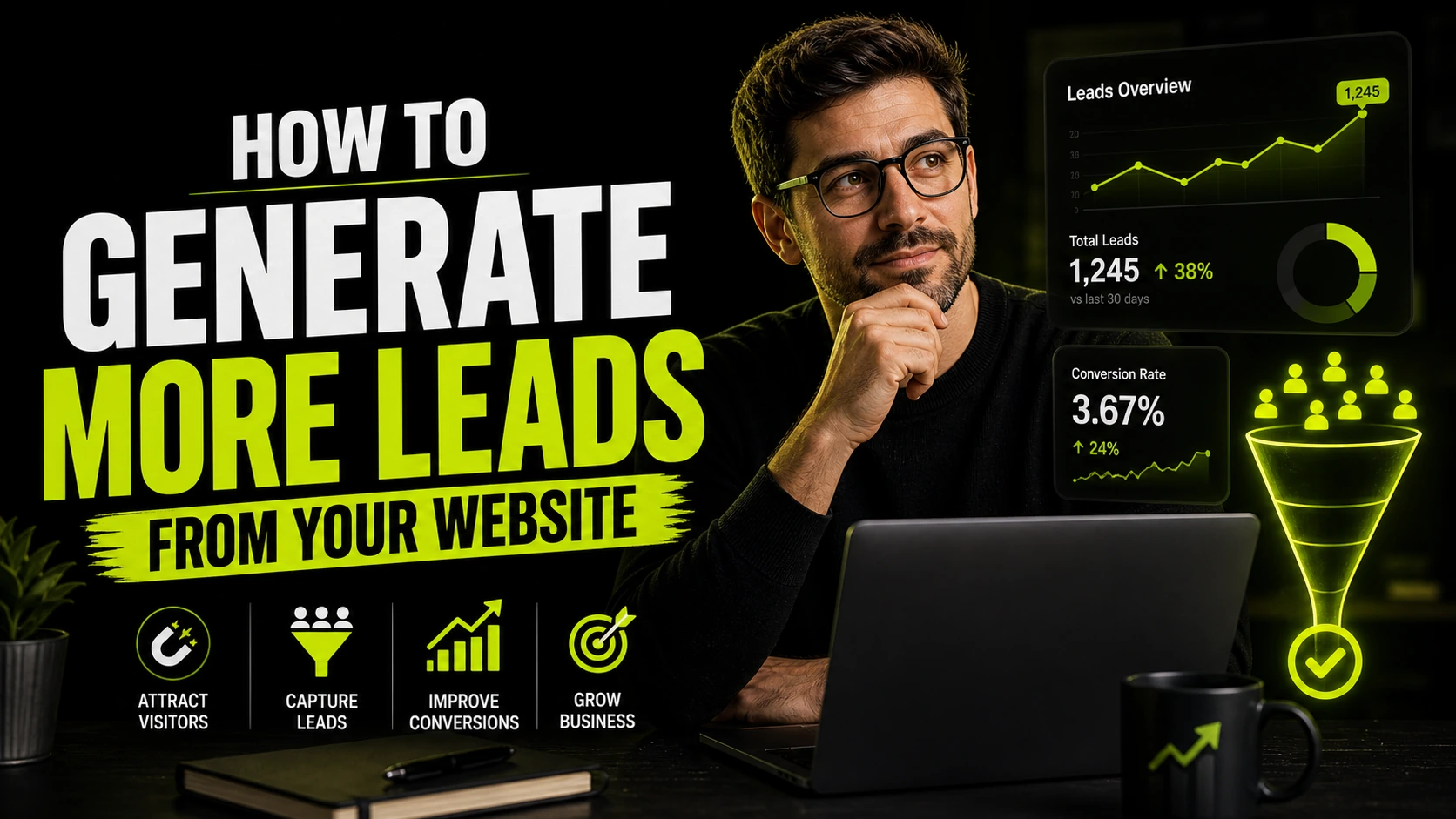
A lot of business websites do not have a traffic problem. They have a conversion problem. People visit, scroll, maybe even spend time on the page, and then leave without calling, enquiring, or booking. If you want stronger website lead generation, the goal is not just to make the site look better. The goal is to make the next step feel obvious, credible, and easy.
The fastest way to get more leads online is usually not “more traffic first.” It is making your current website easier to understand, easier to trust, and easier to act on.
01 Clarify what you do in the first screen
Many websites lose leads immediately because the homepage headline is too vague. If a visitor lands on the site and cannot quickly understand what you offer, who it is for, and why it matters, they will hesitate. Confusion kills conversion faster than weak aesthetics.
A strong hero section should answer three things within seconds: what the business does, who it helps, and what the visitor should do next. If your page tries to sound clever instead of clear, it is probably costing you enquiries.
02 Give every page one primary goal
A website converts better when each important page has a clear job. A service page should drive enquiries. A landing page should drive one focused action. A homepage should route visitors toward the strongest next step. When pages try to do everything at once, they usually do nothing strongly enough.
This is one of the most overlooked parts of website conversion optimization. Clarity of purpose usually matters more than adding more content blocks or more buttons.
03 Improve the call to action
If your CTA says something vague like “Learn More” everywhere, you are probably missing opportunities. Better CTAs make the action feel specific and low-friction. “Get a Quote,” “Book a Free Call,” “Request Pricing,” or “See Project Examples” often perform better because they tell the visitor exactly what happens next.
The best CTA depends on buying intent. Someone early in research may not be ready to contact you, but they might be ready to view case studies, pricing information, or a relevant comparison article first.
Good CTA qualities
- specific, not generic
- placed near decision points
- repeated naturally on longer pages
- matched to user intent and confidence level
04 Show proof early
People hesitate when a website makes claims without evidence. Social proof, recognisable clients, testimonials, case studies, ratings, metrics, before-and-after examples, and real project screenshots reduce that hesitation. Trust should not be buried near the footer. It should appear close to your core promise.
This matters especially for service businesses where the visitor is evaluating risk. They are not only asking “can you do this?” They are also asking “can I trust you to do this well?”
05 Make your service pages more specific
Generic service pages rarely convert well. If your copy could describe ten different agencies or freelancers, it is probably too broad. Stronger pages speak directly to the problem, audience, and outcome. They make the visitor feel understood.
This is one reason comparison and problem-solving articles can support lead generation well. A page that explains a buyer’s situation clearly often builds more trust than a page that only talks about the business itself. That same thinking also shapes how I approach the web design service page.
06 Reduce form friction
Long forms often reduce conversion unless the lead is already highly motivated. If you ask for too much too soon, people drop off. Most businesses do better when they ask only for what is needed to start the conversation: name, email, phone, and a short message or goal.
You can always gather more detail later. The first objective is to get the lead to raise their hand.
Every extra field in a form should justify its existence. If it does not meaningfully improve qualification, it may just be blocking good leads.
07 Improve mobile experience first, not last
A website that looks acceptable on desktop can still lose leads badly on mobile. Buttons may be hard to tap, forms may feel annoying, sections may be too dense, and slow loading can kill trust before visitors even read the offer. If you want to increase website conversions, mobile UX has to be treated as a lead-generation issue, not just a design issue.
That is closely tied to performance too. A slow page creates doubt and impatience. The article on mobile speed goes deeper into why this gap hurts results so often.
08 Build dedicated landing pages for high-intent traffic
Sending every visitor to the homepage is a common mistake. If someone clicks an ad, searches for a specific service, or arrives from a niche campaign, they should land on a page built for that intent. Better alignment between traffic source and landing page usually leads to better conversion rates.
A focused landing page should match the promise that brought the visitor there. The headline, content, proof, and CTA should all support the same outcome.
09 Answer objections before people ask
Many visitors leave because the website does not reduce uncertainty. They want to know pricing range, timeline, process, experience, location, support, or whether the service is a fit for their type of business. Good pages address those concerns proactively.
FAQ sections help here, but so does better page structure overall. The more uncertainty you remove, the easier it becomes for a visitor to take the next step.
10 Use case studies instead of only claims
Case studies are one of the strongest lead-generation assets a business can have because they show real outcomes, not just promises. They help visitors imagine what working with you might actually look like. That is especially valuable when the buyer is comparing multiple providers.
If you have real project evidence, surface it more often. Link to relevant examples from service pages, pricing pages, or comparison content. Visitors trust demonstrated work more than generic capability statements.
11 Bring the right traffic, not just more traffic
Getting more visitors does not automatically mean getting more leads. Traffic quality matters. If a page ranks for broad curiosity queries but your business needs buying-intent enquiries, the conversion gap will stay frustrating. This is why get more leads online is not the same problem as “get more clicks.”
SEO, Google Ads, local search, and content should all be aligned to commercial intent where possible. If the traffic source and page purpose do not match, results stay weak. That is also why the comparison in SEO vs Google Ads matters so much for small businesses.
12 Make pricing and process feel less mysterious
A lot of potential leads disappear because the business feels hard to evaluate. If visitors cannot tell what the next step involves, how you work, or whether you are likely to fit their budget, they may leave without contacting you. You do not need to publish full pricing if that does not fit your model, but some form of range, process clarity, or expectation-setting usually helps.
Transparency reduces hesitation. And when someone is a bad fit, a clearer page helps filter them out earlier too.
13 Add secondary conversions for visitors who are not ready yet
Not everyone is ready to enquire on the first visit. That does not mean the visit is lost. Secondary conversions such as downloading a guide, viewing pricing, checking project examples, subscribing to updates, or saving a comparison article can keep the relationship alive.
This is especially useful for longer consideration cycles. A visitor who is not ready to contact you today may still become a lead later if the website gives them a lower-commitment next step.
14 Track where leads actually drop off
Real conversion improvement comes faster when you know where people hesitate. Look at which pages get traffic but no enquiries, where forms are abandoned, where mobile performance drops, and which CTAs are ignored. Without that visibility, many websites keep making design changes that feel productive but do not move results.
Website lead generation improves when decisions are based on user behavior, not guesswork alone.
Useful things to watch
- which service pages get traffic but few enquiries
- which devices convert worst
- where users stop scrolling
- which forms get started but not completed
- which CTA placements actually get clicks
15 Treat design as a business tool, not decoration
The reason lead-generation conversations often disappoint is that many businesses still think website improvement means “make it look nicer.” Better visuals can help, but only when they support clarity, trust, and action. The real job of design is to make the business easier to understand and easier to choose.
That is why strong websites generate more leads. Not because they are flashy, but because they remove doubt, guide attention, and make the right next step feel natural.
More leads usually come from less friction
If your website is already getting visitors, the next win is often hiding in clarity, trust, speed, landing-page quality, and CTA strength. Better website conversion optimization is usually simpler than businesses expect, but it requires looking at the site as a sales tool, not just a digital brochure. If you want help improving that foundation, you can review recent website projects or get in touch here.
FAQ
Common questions about How to Generate More Leads from Your Website
A quick summary of the most common questions readers have about this topic.
The biggest gains usually come from clearer messaging, stronger calls to action, better landing pages, faster mobile performance, trust signals, simpler forms, and traffic that matches buying intent.
Website lead generation is the process of turning website visitors into enquiries, calls, form submissions, demo requests, or other actions that can become sales opportunities.
Increase website conversions by improving clarity, reducing friction, matching pages to user intent, making the next step obvious, and removing anything that causes hesitation or confusion.
This often happens when the page is attracting the wrong audience, the offer is unclear, trust is weak, the form is too demanding, or the page experience is too slow or confusing on mobile.
Small businesses usually get more leads online when they combine better website conversion optimization with search visibility, landing-page clarity, trust-building content, and clear service positioning.